Sunday, October 24, 2010

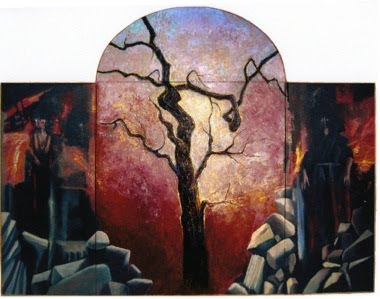
Great Trees

So Abram moved his tents and went to live near the great trees of Mamre at Hebron, where he built an altar to the LORD. (Genesis 13.18)


He is like a tree planted by streams of water, which yields its fruit in season and whose leaf does not wither. Whatever he does prospers. (Psalm 1.3)

An Unorthodox Gesture

The patriarch we know as Abraham spends his first 99 years as “Abram,” which translates as “exalted father.” It’s an honorific suggesting the paternal instincts that drew God to him are native to his character. Abram can be counted on to care for his family and sacrifice for their benefit. He’s an even-tempered man—a gentle, good man—living in a primitive age of uncertainty and flux. He belongs to a nomadic people that doesn’t own property or build houses. Their community consists of extended family whose members share one campsite, combining their property for mutual security and benefit. When joint holdings exceed their capacity to manage, they divide their property, with one faction remaining while the other moves on. This occurs when Abram obeys God’s call to leave his father’s camp for a new land: “He took his wife Sarai, his nephew Lot, all the possessions they had accumulated and the people they had acquired in Haran, and they set out for the land of Canaan, and they arrived there.” (Genesis 12.5)

The journey doesn’t go well at first. Not long after they arrive in Canaan, famine strikes. Abram decides they should go to Egypt. Before crossing the border, he tells Sarai (later, "Sarah"), “You’re so beautiful. If the Egyptians know we’re married, they’ll kill me to have you. If we say we’re brother and sister, they’ll treat me well.” As predicted, Sarai gains Pharaoh’s notice. He brings her to his palace and showers gifts on Abram. Still, the arrangement surely grieves the couple. God intervenes by sending sickness to Pharaoh’s house. When he figures out the cause of his trouble, he sends Abram, Sarai, and their household (including the wealth they acquired in Egypt) away. They continue to prosper until fights break out between Abram and Lot’s herdsmen. After they decide to separate, Abram breaks with custom. It’s not in him to allow Lot to leave while he stays put. In an unorthodox gesture of care and respect for his nephew, he also leaves. Lot moves to the plain of Jordan, near Sodom and Gomorrah. Abram’s choice is rather odd, yet very telling. He moves his family and flocks to Hebron, near the Mamre forest famous for its great trees.

Seeking Stability

Why would a wealthy nomad homestead at the edge of a forest and not an open plain? Pasture is limited. Odds increase that livestock may get lost in the woods or killed by predators that proliferate there. Thieves may use the forest as a covert place to launch a heist of Abram’s herds. Trees abutting his campsite significantly encroach on available farmland and endanger his crops by housing birds and pests that destroy them. Lot appears to make the wiser decision, choosing a site where future prosperity is all but assured. Again, we ask: why would Abram move somewhere that very well may compromise his wealth and security?

The only imaginable reason for Abram’s decision suggests he’s not concerned with possessions and safety. The vast majority of his property came by way of divine providence. The same holds for security. By all rights, his deception of Pharaoh should have ended with him and Sarai stripped of everything and killed. Abram left Egypt with more than his life and goods. He came away knowing God’s faithfulness and protection. He moves near the Mamre forest because he’s seeking stability. He needs to be surrounded by rootedness and strength. He’s surviving on God’s pledge he will father a great nation. Yet, as of now, nothing indicates the promise will materialize. He and Sarai can’t start a family. His surrogate son is gone. The land where his promised heirs will one day dwell belongs to another people. He’s outnumbered and outdone and all his moving around has got him nowhere. Abram looks to the great trees of Mamre because deep inside him he realizes if he’s to succeed in the role he’s been given, he has to be a great tree himself.

Trees in the Process

It’s very idealistic, the notion of becoming a great tree. But what does that look like in pragmatic terms? Psalm 1 beautifully lays them out. It starts by teaching us where great trees don’t grow. “Blessed is the man who does not walk in the counsel of the wicked or stand in the way of sinners or sit in the seat of mockers,” verse 1 reads. To become a great tree, one must be removed from harmful influences and mindsets, unhealthy environments, and cynical attitudes. They invite darkness that stifles growth and twists development. Next, the psalmist tells how great trees grow: “But his delight is in the law of the LORD and on his law he meditates day and night.” (v2) The stability and strength we seek come from light and nourishment found in God’s Word. It grounds and nurtures us in inexplicable ways that transform our seedlings of faith into great trees of confidence. “He is a like tree,” verse 3 says, “planted by streams of water, which yields its fruit in season and whose leaf does not wither. Whatever he does prospers.”

We are trees in the process of becoming great trees. And we must become great trees because God has given us great tasks. Stability and strength are not nice-to-haves for people of faith; they’re have-to-haves. But too often we get confused about how the process works. We don’t generate stability or strength. They come with growth over time. All we have to do is remove ourselves from unhealthy climates and self-destructive atmospheres so we can remain planted in bright places that encourage growth. And we must be patient, resisting every urge to be anxious about our prosperity and security. In due season, our fruit will blossom. Over time, dangers we presently fear will dissipate. Our leaves will not wither. Whatever we do will prosper.

Sometimes we joke about feeling forced to compromise, saying, “I’m a tree. I can bend.” But we’re not called to be trees. We’re chosen to be great trees. And great trees stand tall and firm so other great trees-to-be can look to them for inspiration and example. In our modern age of uncertainty and flux, there are Abrams all around us, moving closer to us to learn how they can become great trees. Let’s stand apart, stable, and strong for them.

We are trees in the process of becoming great trees because God has given us great tasks.

Friday, October 22, 2010

Too Much--Just Not Enough

The LORD God commanded the man, “You are free to eat from any tree in the garden; but you must not eat from the tree of the knowledge of good and evil, for when you eat of it you will surely die.” (Genesis 2.16-17)

Trees Talk

Trees talk in the Bible—not audibly, but they routinely tell us about ourselves. They reveal how easily we’re tempted by forbidden fruit. They describe our character. They catch us riding too high for our own good. They invite us into their branches when our only hope of seeing Jesus depends on being lifted above the crowd. They attest to our faith. They predict what happens when we bear bitter fruit and explain how we’re knitted together as one organism. They appear in visions to promise healing. Trees have a lot to say in Scripture and we’ll spend the next few posts listening to them. In this post, we attend to the first talking tree—indubitably the Bible’s best-known tree, the one at the center of our drama, the reason why other lessons from trees are necessary.

The Tree of Knowledge

It stands as the centerpiece of Eden: the Tree of Knowledge of Good and Evil. “Here’s how this works,” God tells Adam and Eve. “Do what you want and you’ll do just fine. You’ll be happy. I’ll be happy. The garden will thrive. We can go on like this forever.” But there’s a catch. (See? It’s gone like that from the beginning. There’s always a catch.) “Just keep away from the Knowledge Tree. I know it’s one-of-a-kind. I know I’ve put it in the middle of everything. I know its fruit looks delicious. But you have to ignore it. Take a bite of its fruit and you will surely die.”

For those who don’t like God too much—the ones who can’t reconcile Who He says He is with His up-front cause-and-effect conditions and judgment—this seems like the first of many examples where He stacks the odds against us. Why put the tree there at all? If we couldn’t have it, why tempt us with it? Why tell us to stay away, subtly planting the idea we should try it to see what happens? And what does He use to leverage His edict? Death—a concept as alien to Adam and Eve as Hell (a.k.a. “The Second Death”) is to most of their offspring. Why, why, why? You don’t have to be disenchanted with God’s methodology to ask these questions. If Eden is supposed to be perfect, it’s fair to question why He introduces a way to potentially ruin it. The answer isn’t buried in our nature, the Tree’s nature, or even nature itself. It’s hidden in plain sight, in the context surrounding all those natures. And it’s pretty basic.

A New Faculty

Outside of God Himself (Who is absolutely perfect), perfection is a conditional quality that can only exist opposite imperfection. In fact, all of creation is conditional. We know, for instance, what light is by what it is not and vice-versa for darkness. We distinguish the elements—land, water, and air—more concretely as not like each other than what they actually are. Organizing the world by opposites is instinctive. It’s inherited from our Creator Who, from His first appearance in Genesis, reveals Himself as a categorical Thinker. Without potential imperfection, sorrow, and death, there is no potential for perfection, joy, and eternal life. So the Knowledge Tree’s potential destruction of perfection isn’t made for that eventuality. Actually, it’s designed to establish perfection, a world of beauty and emotion sustained by instinctive innocence. As Adam and Eve soon learn, however, the slightest taste of knowledge trumps the full flavor of instinct every time. Before they disobey and bite into the Knowledge Tree’s fruit, they sense things rather than know them. They experience the world objectively, without any fear or caution. Once they know, however, they have a new faculty. They can discern good from evil, right from wrong. The author of Genesis says, “The eyes of them both were opened and they knew.” (Genesis 3.7; KJV) The serpent promises they won’t just be surrogates for God, they’ll be like Him in every way and he doesn’t mislead them. God reserves knowledge for Himself but—true to form—His obsession with polarity compels Him to make it solely His by putting it at risk.

A Ruinous Legacy

We were never meant to discern good from evil. It was never God’s intention to burden us with judgment of any kind. His only purpose for creating us in His image and breathing His life into us was to bring Him pleasure by reflecting His goodness in His world. Had Adam and Eve resisted the Knowledge Tree’s temptation, all we see and know about this place and one another would be good. I couldn’t question your making. You couldn’t doubt mine. Each of us would be uniquely shaped, yet we’d intuitively realize God’s reflection equalizes us. Would we still make mistakes? Yes. Innocence doesn’t ensure infallibility. Would we be susceptible to temptation? Yes. Evil’s presence would remain for goodness’s sake. But inability to discern good from evil would relieve our need to apply what we took from the Knowledge Tree to what we experience in the world. Though we would be no less human, weaknesses and vanities that thwart our flesh wouldn’t be perceptible to us. Instead of being victims of sin, we would be vessels of grace—which is what we truly are.

Last week’s observance of John Lennon’s 70th birthday flooded us with replays of “Imagine”—a song I find lamentable for its agnostic premise. Pretending we’re not accountable for good and evil, right and wrong won’t lift the burden of Adam and Eve’s recklessness. If only it were as easy as imagining the tree incident never occurred! But it did and, seen literally or metaphorically, its truth holds. Biting into forbidden fruit taught us too much—just not enough by yielding not one grain of God’s wisdom. The Knowledge Tree reminds us the faculty we use to condemn others was stolen and consumed under Evil’s influence. It’s a fallacy to think sinfully gained knowledge can assess sin. It’s even more foolish to presume knowing what God knows with none of His wisdom qualifies us to judge in His name. That’s why confessing we can’t possibly understand what we know reconciles us to God. It’s not our knowledge that pleases Him, but our desire to be what He created us to be, mirrors of His goodness and vessels of His grace.

(Portions of this post first appeared in Straight-Friendly: The Gay Believer’s Life in Christ in a slightly modified form.)

We stole and consumed the knowledge of good and evil under Evil’s influence. It’s a burden we were never meant to carry, a faculty we’re not sufficiently equipped to use.

Thursday, October 21, 2010

What's in Your Hand?

Moses answered, “What if they do not believe me or listen to me and say, ‘The LORD did not appear to you’?” Then the LORD said to him, “What is that in your hand?” (Exodus 4.1-2)

The Catalyst

Last week at A Feather Adrift, Sherry posted a provocative piece about hero-worship run amok called “And Another One Bites the Dust”. The dust-biter in question was NY Jets Quarterback Brett Favre, the latest married sports hero to—in his case, literally—expose his reckless libido. Around the time I read the post, I traded emails with the astonishingly courageous, caring mother of a transgender high school freshman. Our exchanges centered on protecting her son from bullying and potential violence. Understandably, his instincts urge him to be as invisible as possible. Yet as a gay man who survived high school, as well as a former teacher, I encouraged the opposite. “What is he good at?” I asked. “He should make his gifts known and excel at them. That will win him friends, gain his teachers’ respect, and increase his self-confidence.” Bullies prey on loners. But they think twice about attacking kids who have friends and faculty on their side. No doubt he’ll be teased and threatened. Still, it’s far safer and healthier to be visible and known than hiding in anonymity.

In terms of heroism, these two unsung giants dwarf Favre. Though his talents are abundant and he’s parlayed his fame into many noteworthy endeavors, it’s ludicrous to suggest weekly confrontations on a football field remotely compare to the challenges our new friend and her son face daily. As the son matures into an adult who honors his making as an authentic female, they will undergo many tests. They will make huge sacrifices. They know this, because they’ve already done it. But they will succeed because their love for one another and God’s grace will endure. Praying for and thinking about this dynamic duo convinces me makings of legitimate heroism reside in all of us. Finding and nurturing our heroic potential starts with one question: “What are you good at?” Or, to quote the question God uses as the catalyst for Moses’s transformation from homeless outlaw to heroic leader, “What’s that in your hand?”

An Oddball His Whole Life

One might describe the Moses story as a fairy tale that explodes into myth. The front end grips us with primal emotions affixed to the helpless infant miraculously rescued from death by a princess. The back end overwhelms us with the grown man’s amazing bravado as he defies Pharaoh, leads his people out of captivity, and shepherds their 40-year wilderness crossing. The improbabilities on both sides create one of the most riveting tales ever told—which is why the reeds and roaming garner the most attention. Without the mid-section, though, the story falls apart. That’s where Destiny calls and the decisive moment occurs. It’s unfortunate we skate by this part of the saga, because Moses is never more real to us than here. He’s neither helpless nor heroic. He’s ineffably human.

He’s extremely confused about his identity and the bizarre twists of fate that led him to the middle of nowhere. While being groomed as a prince of the world’s most powerful nation, a Hebrew governess (his birth mother) also steeped him in the faith and values of his race. He’s felt like an oddball his whole life. Deep inside, the tug-of-war that began the day Pharaoh’s daughter found him slowly mounts into a full-blown identity crisis. It peaks when Moses sees an Egyptian beat a Hebrew slave. He identifies with the underdog and murders the Egyptian in retaliation. Instead of resolving his conflict, the act confirms he’s too Egyptian for the Hebrews, too Hebrew for the Egyptians. Slaves who witnessed his valor suspect him of ulterior motives; Pharaoh issues a death warrant against him.

After fleeing to Midian, Moses marries the daughter of a pagan priest and names his first son “Gershom,” a Hebrew homonym meaning, “alien in a foreign land.” He supports his family as a shepherd—a vocation his upbringing didn’t prepare him to undertake. The job entails long sojourns to find pasture for flocks he doesn’t own (they’re his father-in-law’s). During one trip, God appears to Moses in a blazing bush, ordering him to return to Egypt and organize a Hebrew revolt. Since the slaves view him suspiciously, he asks, “What if they don’t believe or listen to me and say, ‘The LORD didn’t appear to you’?” God answers with a question: “What’s that in your hand?” It's a staff. God tells him to let it go. It turns into a snake. Naturally, Moses jumps away from it. “Grab its tail,” God says. When Moses picks it up, it returns to a staff. “That ought to cancel any doubts,” He says. (Just in case, however, He gives Moses two more feats to back him up.) And now, having cleared up worries about everyone else, Moses comes clean with his doubts. “I don’t know,” he says. “I’m not much of a talker. You want a charismatic, well-spoken person. I’m not Your guy.” God’s ready with a solution for this, too. He tells Moses to take his brother, Aaron—an articulate priest accustomed to public speaking—as his spokesperson. The rest you know.

Defined by Deficits

Lingering with Moses at this point in his story, we see a man defined by deficits. He has no self-confidence, political backing, cultural security, social standing, financial stability, remarkable talents or skills, and, from all indications, no driving ambition. His appearance isolates him from his people; his turmoil sends him from his adopted home. Dual upbringing, which should equip him with every advantage, proves useless. He ends up a stranger in a strange land, married outside his faith, with children who, by matriarchal lineage, aren’t Jews. Little wonder he’s timid and tongue-tied. But he’s got something. It’s right there in his hand. There God recognizes his heroic potential. Moses uses his staff to corral his flock, steady himself on rugged terrain, fight off predators, clear thickets, and anchor his climb up steep hills. Moses is a shepherd and a shepherd—not a prince or slave—is what God needs.

God asks us, “What’s that in your hand?” All heroes start by answering that question. At first, what we’ve got seems mundane and inconsequential. What we do with it doesn’t become heroic until we recognize deficits that define us give way to powers that transform us. Unconditional love and acceptance is a staff. Faith is a staff. Experience, hospitality, humility, determination, self-honesty, wit, wisdom, empathy, etc.—they’re staffs. We hold makings of heroism in our hands. We just have to see them for what they are and allow God to show us all they can be. What’s in your hand?

Each of us holds makings of heroism in our hands.

Sunday, October 17, 2010

Breaking Cycles

In those days people will no longer say, “The fathers have eaten sour grapes, and the children’s teeth are set on edge.” Instead, everyone will die for his own sin; whoever eats sour grapes—his own teeth will be set on edge. (Jeremiah 31.29-30)

A Toxic Notion

The rendering of Mosaic Law during Israel’s wilderness experience gave birth to a toxic notion we’ve yet to eliminate. It lives today as a proverb: “The parents' sins are visited on the children,” which we take to mean every generation must pay for its ancestors’ mistakes. There’s no getting past the fact God warns of this fate numerous times. It’s literally writ in stone, attached to the Second Commandment forbidding idols: “You shall not bow down to them or worship them; for I, the LORD your God, am a jealous God, punishing the children for the sin of the fathers to the third and fourth generation of those who hate me.” (Exodus 20.5; emphasis added.) The italicized phrase, word-for-word, appears four more times in the Talmud, with several variants amounting the same thing.

Accepting it as-is startles us, because there’s also no getting past the fact it’s patently unjust and cruel. Why would God punish one’s children (let alone, their children and their children’s children) for parental disobedience? It’s a curse that defies reason and contradicts everything we know God to be. It also discourages us from overcoming our parents’ weaknesses. If we’re going to suffer for their sins, why resist the same impulses that led them astray? This is pretty much how Israel responds to God’s warning. In resigning themselves to bear the brunt of their forebears’ wrongdoing, they grant themselves license to perpetuate their errors. We live with this poisonous mentality even today: “I come from a long line of alcoholics.” “My dad was abusive, which is why I’m a mess.” “My mom has a bad temper, so naturally I fly off the handle.” “Because my family are hypocrites, I want nothing to do with religion.” The sins-of-the-parent script practically writes itself. Since it’s a self-fulfilling prophecy, its reliability is guaranteed.

The Parent Card

But there’s a problem with the formula—a big one that highlights how crazy and mixed-up such thinking is. It’s based on reading God’s warning backwards, from the kids’ angle, not the parents’, which blatantly distorts its purpose and meaning. When God says, “Don’t do this, or else the damage will live on for generations,” He’s issuing preventative policy, not punitive threat. What’s more, He isn’t speaking to children at all. He’s talking to parents. He’s stressing their duty to break cycles instead of repeating them. It’s backwards to read these warnings as ground rules for a blame-game, where dropping the Parent Card entitles us to a free pass for our misbehavior. And here’s why: our contribution to cyclical defeatism and disrespect casts us in parental roles. Whether or not we have biological offspring, embracing toxic ideas and behaviors conceives and nurtures a new generation of destructive tendencies. It’s no longer about what we’ve been saddled with. It’s the burden we’re saddling on future lives.

Israel never figures this out. Every time their story takes a terrible turn, they throw up their hands and say, “We knew this would happen, because our parents were so rebellious. It’s not our fault we’re just like them.” It never occurs to them they can break the cycle. It never crosses their minds they suffer because they prefer the blame-game to changing the game. This goes on for centuries, until God finally changes all of the rules. He raises a prophet, Jeremiah, to tell Israel: “We had covenant. We set down terms and conditions. Ever since, you’ve either ignored them or looked for loopholes to flout them. So I’m voiding the old covenant to issue a new one.” No surprise, one of the first loopholes God closes is the sins-of-the-parent excuse. Under the new paradigm, according Jeremiah 31.29-30, “people will no longer say, ‘The fathers have eaten sour grapes, and the children’s teeth are set on edge.’ Instead, everyone will die for his own sin; whoever eats sour grapes—his own teeth will be set on edge.” God takes the Parent Card off the table. No more blame-game. But—and this is extremely important—He does not relax His expectation that each generation breaks its predecessors’ deadly cycles. Indeed, he ups the ante to ensure it doesn’t. “Everyone will die for his own sin.”

Sour Grapes

The English idiom “sour grapes” has no connection to this text. It comes from Aesop’s fable about a fox that sees a cluster of grapes. After repeated attempts to get them fail, he gives up, telling himself, “They’re probably not ripe anyway. What do I want with sour grapes?” Jeremiah’s usage of “sour grapes” infers much more than resentful equivocation—though that’s part of it. The person who plucks and eats unripe grapes exhibits a bounty of unhealthy traits: impatience, recklessness, lack of wisdom, distrust of others (who may steal his ripe harvest), poor foresight, and selfishness, along with its twin, self-loathing. The discomfort and embarrassment that come of his foolishness don’t faze him. He makes his own misery knowingly. That Jeremiah sets the statement about fathers eating sour grapes in quotes indicates it’s a popular proverb of his day—his readers’ version of “Like father, like son.” And when he smashes it with “whoever eats sour grapes—his own teeth will be set on edge,” he invokes another popular modern proverb: “Monkey see, monkey do.”

We are not obliged to embrace the fears, prejudices, presumptions, and myths of earlier generations. The onus rests on each of us to evaluate everything we’ve heard, learned, and seen in terms of how truly they reflect God’s expectations and Christ’s teaching. Our parents’ sins are theirs to account for. When we credence them by repeating them or exploit them to excuse our weaknesses, cycles that deeply hurt us will persist. We deserve better than sour grapes. So do those following us. We break cycles of bitterness and failure by claiming Christ’s promise in John 10.10: “I have come that they may have life, and have it to the full.” Sweet life, rich life, abundant, healthy life—that’s what the new covenant offers. That’s what breaking destructive, defeatist cycles brings.

Embracing or blaming previous generations’ mistakes perpetuates destructive cycles. God calls us to break them. We do this by accepting Christ’s promise of abundant, healthy life.

Friday, October 15, 2010

Nothing to Drink

I was thirsty and you gave me nothing to drink. (Matthew 25.42)


(With a grateful hat-tip to Jan, of Yearning for God, who brought the date to my attention.)

Bubblers

Years ago, Chicago parks were outfitted with bubblers—six-sided cement water fountains that flowed non-stop. They were just tall enough for a six-year-old to tiptoe against and lean into for a quick gulp before returning to play. The water was, without question, the sweetest, coldest, and most refreshing I’ve ever tasted. Bubblers were also exciting to us because we were expressly forbidden to drink from them, due to high frequencies of communicable diseases like mononucleosis, strep throat, and rheumatic fever. Although we’d been vaccinated against many of these illnesses, the risk of contracting a crippling infection was too great. So we were repeatedly warned, “Stay away from the bubblers or you’ll get sick.” But how can a child who’s worked up a tremendous thirst look at a bubbler—or any other freshwater source—and see potential danger?

Ours to Correct

Thirst is an immediate, primal need. Unless readily available water is noticeably tainted, thirst will overrule reason every time. This is true for people and animals of all ages. The possibility of eventual sickness loses its import when the need to replenish depleted fluids takes over. Since the vast majority of water-borne diseases have no discernible taste, it’s very easy for long-term health concerns to evaporate on demand. In areas where clean water supplies are low or non-existent, aid workers report tremendous difficulty convincing locals that imperceptibly polluted drinking water and widespread epidemics are linked. Furthermore, in places where the only available water undeniably runs thick with deadly microbes and chemicals, residents are apt to acquire a taste for it. Dying of thirst or dying of disease amount to the same thing: dying. In these situations, a perverse logic takes hold. Remedies for water-borne sicknesses are typically easier to find and administer than solutions for untreated water sources.

In many places, quenching one’s thirst constitutes a death-dance. It’s very hard for people who drink worry-free from taps and fancy-labeled water bottles to comprehend that. Imagining such a thing is so far beyond the pale we tend to set it aside—as if letting Mother Nature worry about the crisis is the most sensible response. But she’s got no worries, because she’s not to blame. We’ve made this mess by treating her streams as our trash disposals, rerouting her rivers for our purposes, and assigning value differentials to human, plant, and animal life based on profit motives. It’s chilling that we can wrap our heads around the literally godforsaken notion it’s permissible to violate remote peoples and places if mining their minerals and befouling their deltas raise our standard of living. Rogue corporations and tycoons treat Africa, Asia, and parts of Central and South America as though they’re barren planets: get in, get the goods, and get out, all the while soaking the terrain with toxins that wash downstream, leech into freshwater aquifers, and destroy the natural balance created to safeguard against diseased and deadly water. We created the crisis. It’s ours to correct.

Data and Biology

Jan posted some powerful data on her site that’s worth sharing here:

  • Every 20 seconds a child dies from a water-related disease.
  • 890 million people lack access to safe water.
  • 2.5 billion people don’t have a toilet, roughly 1 in 3 of us.
  • $25 brings one person clean water for life.
  • 200 million hours of labor are consumed daily to collect water—i.e., our “modern world” is nowhere near as modern as we think.
  • Improperly disposed and untreated human and animal waste is the primary cause for global illness.
  • More people on the planet have mobile phones than toilets.

Now let’s add biology into the mix:

  • On average, water comprises 55-60% of the human organism.
  • Virtually every bodily function relies on it for chemical reactions, purification, and waste elimination.
  • Dehydration sets in with a 5% reduction in water content.
  • Severe, often fatal dehydration occurs when body water is reduced by 10-15%.
  • Since the largest populations without clean water are concentrated in tropical and subtropical regions, dying of thirst is hardly a metaphor or figure of speech for them. Indeed, that’s what ultimately what kills most who suffer with water-borne illnesses due to nausea, perspiration, diarrhea, and cellular decomposition.

A Life-and-Death Issue for Us All

Universal access to clean water is an urgent global imperative and moral responsibility. But believers have the added obligation to care for the thirsty in obedience to Christ. To know this need exists and ignore it condemns us with neglect. In Matthew 25, Jesus gives us a glimpse of how we’ll be judged. He compares the process to a herder dividing his sheep and goats. The herder groups sheep to his right and goats to the left. He welcomes the sheep into his fold, naming all the good things they did for those in need, never mentioning “them.” He personalizes it, saying, “Whatever you did for one of the least of these brothers of mine, you did for me.” (v37) Jesus lists caring for thirsty people among the compassionate deeds the herder rewards. The same criteria apply to the goats, who minimized others’ needs and suffer dire consequences. “I was thirsty and you gave me nothing to drink,” the herder tells them. The goats protest, “We always took care of you!” Here’s how the story ends: “He [the herder] will reply, ‘I tell you the truth, whatever you did not do for one of the least of these, you did not do for me.’ Then they will go away to eternal punishment, but the righteous to eternal life.” (v45-46)

There we have it. Thirst is a life-and-death issue for all of us. It kills those we neglect and, as long as we ignore the clean-water crisis, exposes us to an even grimmer fate. Simply put, as long as we’re in the world, there’s no excuse for one soul perishing to thirst and water-related disease.

Accessible, clean water we take for granted is a godsend to millions. As God’s agents, we must send it to them.

Postscript: Obedience Outlets

There are hundreds of organizations working to solve this crisis, all of them needing our time and means. They’re obedience outlets—opportunities to honor Christ’s commandment to care for the thirsty among us. Here’s a very short list of organizations you can contact to learn how to support to their efforts.

The Water Project

Global Water

The Clean Water Fund (US-focused)

Charity: Water

WaterAid

Water.Org

3for5

Just a Drop

(If you’ve worked with or given to other organizations and would like them added to the list, please let me know and I’ll update the post.)

Thursday, October 14, 2010

The Land of Either/Or

Who shall separate us from the love Christ? Shall trouble or hardship or persecution or nakedness or danger or sword? As it is written: “For your sake we face death all day long; we are considered as sheep to be slaughtered.” No, in all these things we are more than conquerors through him who loved us. (Romans 8.35-37)

Cosmic Mash-Up

A great friend moans on Facebook that he’s got an Olivia Newton-John song stuck in his head he can’t pry loose. Everyone jumps to mention other smarmy tunes that glom onto us like gum to a shoe. I flag “The Candy Man” and “Pure Imagination” from Willie Wonka and the Chocolate Factory and think no more of it. Then, this morning, I wake up to find Ms. Newton-John has set up shop in my head. She’s chirping before I hear myself think, a song from Xanadu, no less, one of the worst movies ever made. All she gives me is the hook: “You have to believe we are magic, and nothing can stand in our way.” It loops over and over on the far side of my ears, where I can’t get to it. I try to suppress it during a meeting, but whenever the conversation lulls, there it is: You have to believe... I can’t take it. The instant I get on the subway, I crank my iPod’s “Living in the Past” playlist of Sixties and Seventies hits. I desperately need The Who or The Kinks or The Stones to rescue me. So what shuffles up? The Little River Band’s “Help Is On Its Way”: “Hang on. Help is on its way. I’ll be there as fast I can. Hang on, a tiny voice did say, from somewhere deep inside the inner man.”

Perhaps I’m watching too much “Glee”. Without conscious intent, I’ve concocted a motivational mash-up (not a bad one, either): Hang on. You have to believe. Help is on its way. Nothing can stand in our way. I’ll be there as fast as I can… Is Someone speaking? Not being one who stores much credence in extra-scriptural phenomena, like weeping Madonnas or (wink to Gleeks) Christ’s apparition on a slice of toast, I park the question to see if more back up turns up. Queen’s “Bohemian Rhapsody” follows. See? Just a coincidence, I sigh—until “Beelzebub has a devil put aside for me” gives me a jolt. I ease off to let the music play. Another sigh when Joni Mitchell’s “Help Me” comes on. Then she sings, “Are you gonna let me go there by myself? That’s such a lonely thing to do.” All of a sudden, I’m in the Land of Either/Or: Believe or Beelzebub; Hang On or Help Me; “I’ll be there” or, “Are you gonna let me go there by myself?” I realize I’m in the cosmic mash-up we sort through constantly. Everything we do and say, every response and expectation is shaped either by faith or fear, persistence or panic. Either we trust God for our best or we tremble to imagine our worst. We either hang on, knowing He’s on His way, or we go it alone. We dwell in the Land of Either/Or.

The Principality, Not the Path

I won’t be convinced deciding to follow Christ is tough or complicated. No one can possibly exceed the lengths He’s taken to offer us love and life. Accepting His gift is so clearly the best decision it’s hard work to rationalize rejecting it. The ease in recognizing it’s the right—the only—choice can be misleading, though. When challenges that accompany following Jesus surface, many believers lose their way. They quit without pause, saying, “I signed up to be loved and gain eternal life, not to love haters, welcome strangers, give to receive, break habits, fix attitudes, embrace the impossible, and trust the invisible. How is any of that easy?” We can’t dispute them. None of it seems easy. But the difficulty is caused by the principality, not the path. As we follow Jesus through the Land of Either/Or, each step confronts us with dangers and perplexities that demand responses completely unnatural to the atmosphere surrounding us.

We have to believe we are magic—not in the Harry Potter sense, of course, but in knowing we’re indomitable and impervious to forces that govern Either/Or. That’s why we never tire of hearing Paul’s description of our unique powers in Romans 8.35-37: “Who shall separate us from the love Christ? Shall trouble or hardship or persecution or nakedness or danger or sword? As it is written: ‘For your sake we face death all day long; we are considered as sheep to be slaughtered.’ No, in all these things we are more than conquerors through him who loved us.” Just look at all those “or’s!” Every one of them is a fear-fueled, panic-ridden, completely realistic possibility. Yet when we believe, when we opt for the “either’s”—the choices that test our faith and persistence—nothing can stand in our way. We are more than conquerors through Him Who loved us, Paul insists, removing any question of where our powers lie. Our fortitude, confidence, and hope—our genius—is in the love Christ proved, and the life He promises.

We Are Magic

Paul cites Psalm 44.22 to stress how our meek appearance belies our mighty power: “For your sake we face death all day long; we are considered as sheep to be slaughtered.” The dangers we encounter on the road come from crossing hostile territory and passing derisive personalities. Earlier in the psalm, the poet complains, “You have made us a reproach to our neighbors, the scorn and derision of those around us. You have made us a byword among the nations; the peoples shake their heads at us.” (v13-14) Why is that? Seen from the roadside, we look like sheep headed for ruin, as though we’re so oblivious to the world’s ways we’ll look up to find our Shepherd’s left us in the slaughter pen. “Never!” Paul says. “Nothing will ever separate us from His love!”

Thus, in a very real sense, we are magic, because magic tricks the eye. How we’re seen and what’s said of us is not who we are. We look like sheep on the outside. Inside, we’re more than conquerors. What appears to be mindless compliance is revealed as ingenious obedience. The terrors meant to defeat us are inexplicably transformed into tests that define us. When we should cry, “Help me!” we rejoice, “Help is on its way!” We must always remember everything we see and hear in Either/Or is backwards. Apparent weakness is true strength. Foolishness that’s mocked merits respect for its wisdom. Insults translate into praise, and logical thinking is ridiculed by unnatural faith. Knowing this, we have to believe we are magic. Nothing can stand in our way.

For all practical purposes, the world sees us as oblivious sheep. But our appearance is deceiving. We’re not sheep. Christ’s love makes us more than conquerors.

Postscript: Hang On

Saddling you with Olivia Newton-John’s “Magic” would be a cruelty beyond forgiveness. Instead, here’s a 1978 video of The Little River Band’s “Help Is On Its Way.” I find the bridge particularly powerful:

Don't you forget who'll take care of you

It don't matter what you do

Form a duet - let him sing melody

You'll provide the harmony.

Enjoy!

Wednesday, October 13, 2010

Enoch and Enoch

Enoch walked with God; then he was no more, because God took him away. (Genesis 5.24)

A Mismatched Set

Genesis gives us two men named Enoch, making it easy to confuse them and possibly even conflate them into a single person. It’s important to keep them separate, though, by getting to know both. They’re a mismatched set and distinguishing between them uncovers nuances we’d otherwise miss. The first Enoch is only remarkable for his background, while the second one definitely qualifies as a “seminal figure”—the academician’s pet name for someone who instinctively revolutionizes how future generations think and live.

Enoch 1: Never to Be Mentioned Again

Enoch 1 shows up in Genesis 4.17-18 and vanishes, never to be mentioned again: “Cain lay with his wife, and she became pregnant and gave birth to Enoch. Cain was then building a city, and he named it after his son Enoch. To Enoch was born Irad,” after which three subsequent father-son pairs are listed.

Mining this information yields much gold. 1.) He’s Adam’s first grandson, the earliest offspring of a mortally conceived man, and thus the primary link in humanity’s self-perpetuating chain. 2.) He comes from bad stock. His father’s an exiled murderer. To say his mother’s background is sketchy amounts to gross understatement; we have no idea where she and everyone else in Nod, Cain’s chosen abode, come from. 3.) In keeping with Jewish tradition, she’s a “foreigner,” making Enoch 1 a half-breed. Then, since Judaism defines ethnicity by maternal origins, Enoch 1 effectively is a “nobody” without any claim as Adam and Eve’s heir. 4.) The text hints that Cain names a city for his son to compensate for deficits passed down to him. Alas, Enoch 1 doesn’t accomplish anything worthy of a namesake city. Notable achievements don’t surface on this branch of Adam’s family until five generations later, when the first farmer appears, followed by his son’s musical talent, and the next son’s invention of metalworking. By then, nine generations down the line, Enoch 1 is a faded entry in the record.

Enoch 2: Mentioned Repeatedly and Often

While Cain struggles to establish his family, Adam and Eve have a new son, Seth, who becomes the de facto patriarch of the Jewish race. Ironically, Genesis 5 documents his lineage with no mention of anything inventive or productive. For six generations, all we’re told of each is: “He lived so long. He fathered an heir and other children. And then he died.” Then Enoch 2 appears seventh in line on Seth’s side and does something too spectacular to be ignored. He walks with God.

Like Enoch 1, his story briefly unfolds (four sentences) and then he vanishes. But he’s mentioned repeatedly and often because he vanishes. Genesis 5.24 reports, “Enoch walked with God; then he was no more, because God took him away.” He disappears never to return. While Enoch 1 and the city named for him turn to dust, Enoch 2 is forever remembered because not a speck of him exists on the planet. He breaks the then-he-died mold. He defies convention with something so simple it’s impossible to fathom: He walks with God and is no more. And in doing that, he radically alters humankind’s understanding of how it relates to God and what happens when He’s pleased. To this day, his instinctive drive to build a relationship with his Maker—not a city or a name for himself—influences all we believe God to be and all we hope to gain from Him.

Detachment

As with much in Genesis, the writer drops this bombshell about Enoch without answering many questions. Here’s all we know. When he’s 65, Enoch has his first son, Methuselah. (Yes, that Methuselah—the oldest human on record.) After his son’s birth, Enoch starts to walk with God. We’re not told what prompts his decision. But it's plainly suggested it's somehow tied to fatherhood. We do know engaging a close relationship with God doesn’t disrupt his life, because the writer tells us he continues to father children during the 300 years they walk together. So Enoch isn’t an ascetic who abandons his family to commune only with God in a cave or under a tree. Walking with God implies he moves in constant awareness he’s not alone. He remains present in God’s presence. He welcomes Him into every area of his life. This pleases God so much, when the time’s right, He skips the death process and assumes Enoch directly into His keeping.

Of course, we want to know how it works, particularly since the Bible’s other two assumptions—Elijah’s and Christ’s—include logistical details that go missing with Enoch. (A heavenly chariot whisks Elijah away, while Christ bodily ascends into Heaven.) The walking aspect invites us to imagine the day comes when Enoch defies gravity and climbs into eternal bliss. However we envision his transition, we don’t see him looking back, deeply conflicted about leaving. The devotion captured in three centuries of divine fellowship infers supreme detachment from relationships and possessions. Long before Enoch’s physical transformation, an inner change overtakes his heart and alters his views. He measures life in moments, not popularity and wealth (though we’re wise to suspect he’s well loved and well off, as that’s often typical of those who walk with God.) For Enoch, being lifted into God’s presence is simply the next step. He has no qualms about letting go. The letting-go happened so long ago, it’s possible he’s forgot how to hold on.

The Enoch Principle

What we might call “The Enoch Principle” permeates Christ’s ministry. Nearly everything He says in some shape or form points back to forging a constant, present relationship with God and detaching from people and possessions that hinder our walk with Him. It’s in the stories about risking great loss to achieve greater gain. It underpins the parables that warn against compromising our commitment out of fear of failure, as well as those about overvaluing what we own. Again and again, Jesus calls us to walk with God, from the tender beckoning of “Follow Me,” to the harsh demands we forsake family and fields for Him. And when we take to His road, He’s emphatically clear it doesn’t end. We turn a soft corner and, like Enoch, we are no more, because God takes us away. Walking with God leads to life.

We have a choice, it seems. Are we Enoch 1’s, daunted by circumstances beyond our control—misguided families, social stigmas, and anomalies no one can explain? Are we content to be associated with institutions constructed for our benefit without accomplishing anything of eternal value on our own? Are we OK with showing up, hanging around, and vanishing, never to be mentioned again? Or are we Enoch 2’s? Do we answer life’s challenges by seeking inner change? Do we walk with God? Are we present in His presence? Have we learned to honor our responsibilities without being hostages to them? Can we do the letting-go and train ourselves to forget how to hold on? Will it also be said of us, “They walked with God; then they were no more, because God took them away?”

What we do with what we've been given will determine whether we vanish, never be mentioned again, or vanish, never to return, always to be remembered. It’s our choice.

Walk with God.